

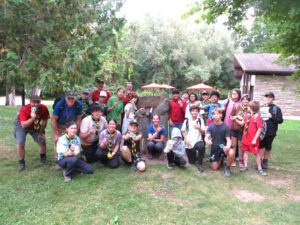
Seeing a school bus full of kids on a Saturday morning is unusual, but this one wasn’t headed to class. On September 13th, 21 Scouts and three leaders arrived at Terra Cotta Conservation Area for a day of outdoor learning and adventure on the Toronto section of the Bruce Trail.
After disembarking from the bus the Hike Leader team (which included Tom Swales, Felix Wan, and myself) described the plan for the day and then we all headed onto the McGregor Spring Trail which connected us to the Vaughan Trail and then the main Bruce Trail. Along the way we stopped to learn about blooming native wildflowers such as Spotted Jewelweed and Canada Goldenrod. We also noticed the edible fruits of Riverbank Grape and Purple-flowered Raspberry and discussed why we shouldn’t eat them, choosing instead to leave the fruit on the plants for native wildlife to enjoy.
We did, however, enjoy the lunches that we brought along ourselves! We set down tarps at the Overnight Rest Area adjacent to the Bruce Trail so we could enjoy our lunch break picnic-style, and afterwards we talked about the importance of packing out whatever we packed in, leaving no trace behind as we continued on our hike.
Our turn-around point was the bridge over Roger’s Creek so we could hear the soothing sounds of water, but before we arrived at the bridge everyone marveled at the striking red colour of the exposed Queenston Formation. Young people are typically curious, and this group was no different. They asked why the rock was so red and I was happy to give an answer: if you leave iron outside for a long time it turns into red-coloured rust; the Queenston Formation is rich in iron and has been outside for a VERY long time and so it has become red, too.
Their curiosity extended to plant identification, too – specifically Poison Ivy. They wanted to know how to identify it and luckily, I found a small patch growing adjacent to the trail so I could show them what it looks like. I told them Poison Ivy is native to Ontario and thus should be allowed to live in its natural habitat despite the inconvenience that it presents to humans. After having a good look at (but not touching!) the Poison Ivy, we continued our hike onto the Terra Cotta Side Trail.
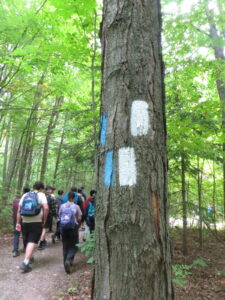
Of course, the youth were wondering about the change in blaze colour as we switched from the main trail to a side trail – another learning opportunity! We paused to have a little chat about what they noticed about the blazes, including how they differ with respect to colour but also the number and position of the blazes. It was at this point – as we passed the “T” blaze indicating one end of the Terra Cotta Side Trail – that most of the youth yelled “Bingo!” Throughout the hike they had been working on a Bingo-style scavenger hunt which focused their attention as they walked. They were looking for a variety of plants, animals, fungi, geographical features, and trail features such as bridges, boardwalks, and blazes, and this special blaze was the last item needed to complete their Bingo card. A small prize for each participant was waiting at the end of the hike which helped them complete the hike with some extra pep in their step.
Where the Terra Cotta Side Trail intersects the A.F. Coventry Trail the group chose the slightly longer hike option, turning right rather than left so that our total hiking distance would be over 5 km, allowing the Scouts to earn an additional badge from their Scouting program.
When we reached the end of our hike the Bingo prizes (peanut-free chocolates) were handed out and a small badge ceremony was held so that the Scouts and their leaders could each be presented with a “My First Hike on the Bruce Trail” badge. To our surprise the Scout group presented Tom, Felix, and I with badges, too! We each received a “20th Scarborough West Scout Group” crest which will be a reminder of the fantastic day we spent with the troop on a lovely September day, showing them wonders of the Bruce Trail.
- Courtesy, Monica Pasquali